- Ten ni aru mono: Chi ni aru mono (Episode 一)
- Safaru ni saku bara (Episode 二)
- Dai Katun Borakuchin (Episode 八)

- المتنبي
- Al-Mutanabbi
I don’t like to be a passive reader, for that, I needed to write some rejoinders for this entertaining anime.
Ten ni aru mono: Chi ni aru mono (Episode 一)
Is Theology lacking behind other sciences?
Am sure this can be answered by theologists from all of the spectrum, but I want to give an non-convoluted islamic answer to this.
Muhammad says in a letter to his family after mentioning a number of scientific fields: “Unlike theology, in which you simply parrot what you are taught, science is knowledge built upon real-world experience gained by scholars. I find this manner of learning far more agreeable.”
Islam is a way of life, natch. So categorically framing it in whole exclusively as a science is inadequate, that was not the writer’s intention anyway, what Muhammad meant given he used the word “theology” is the study of islam’s beliefs, named ʿaqīdah (عَقِيدَة), and it’s jurisprudence, termed Fiqh (فِقْه), in that case, the claim -or rather the sentiment- is easily rebuttable by naming the various school of thoughts that each one of the two encompasses, in Aqidah for example, there is Hanbalism (might be called Salafism), Ash’arism, and Maturidism, for Fiqh, there is the Hanbali branch, the Maliki branch, the Shafi’i branch, and the Hanafi branch, and since this pluralism of approaches exists, “parroting” becomes far-fetched, and the space for interpretation, debate, and invention, becomes more visibly spacious.
I know this was more of a sentimental statement made by a passionate kid that was quelled by a tiresome teacher in his hometown, but the statement came out as a more of a factual claim that I felt the need to expressively refute it.
Safaru ni saku bara (Episode 二)
In this episode Anis tries to comfort Fatima and convince here to put off the blame from her back by giving her an example from islamic jurisprudence where the slave generally receives the half the punishment a free man would.

That rule exists. in fact it’s mentioned in the Quran:
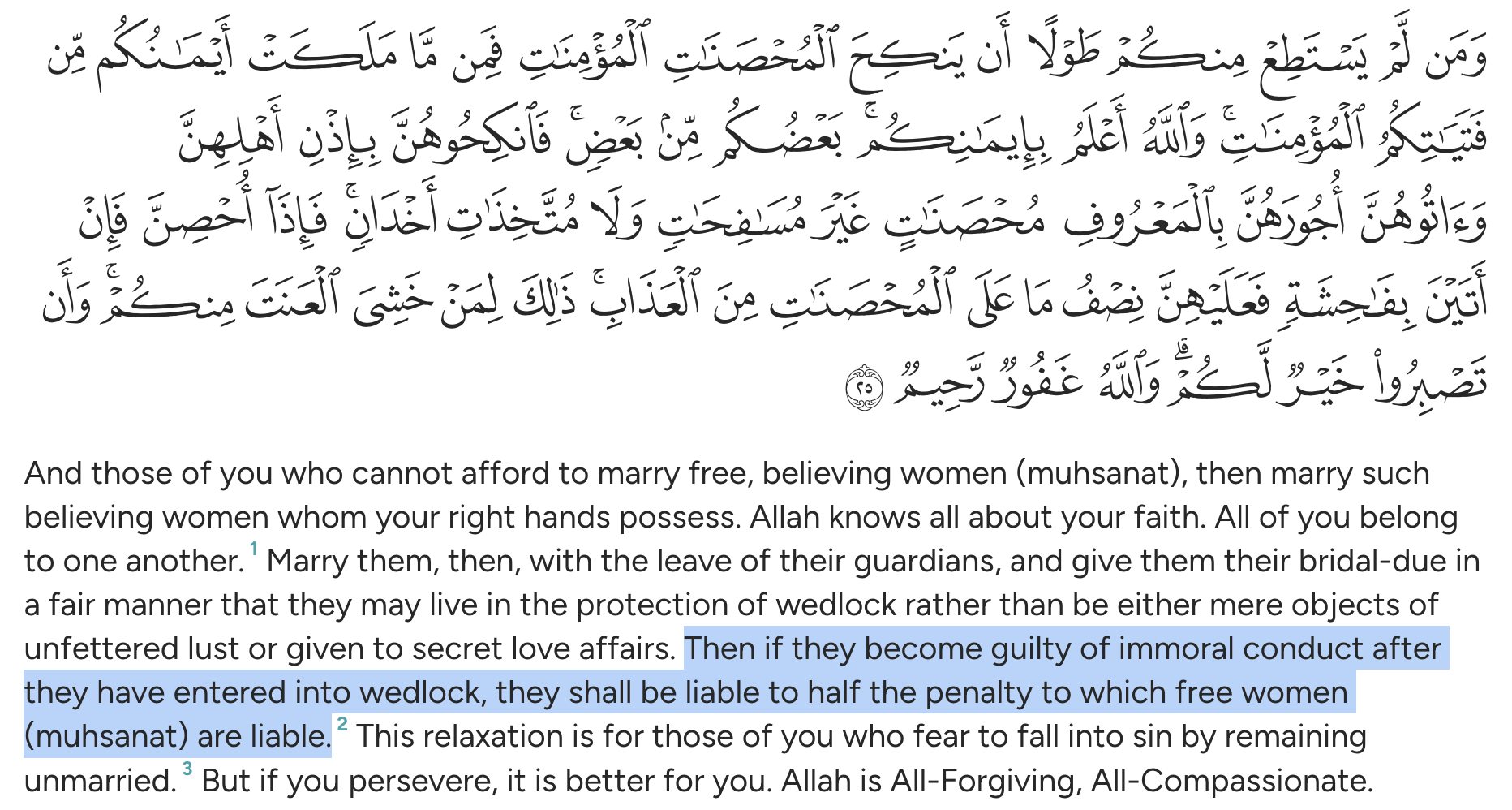
In terms of the rationale behind this, I’ve found Tafsir al-Qurtubi to have a well-put explanation, freely translated:
“The wisdom behind the reduction of their Hadd (prescribed punishment) is that they (female slaves) are weaker than free women. It might be also that they do not attain their desires [for marriage/intimacy] as free women do.
Also because punishment is proportionate to the blessing. Do you not see that Allah Almighty said to the wives of the Prophet (peace be upon him): “Wives of the Prophet, if any of you commit flagrant indecency, her chastisement shall be doubled1. That is easy for Allah.” [Al-Ahzab:30]? Since their blessings were greater, their punishment was made more severe. Likewise, female slaves, since their blessings are fewer, their punishment is lesser.
The verse specifically mentions the Hadd for female slaves, and does not mention the Hadd for male slaves. However, the Hadd for male and female slaves is the same: fifty lashes for Zina (unlawful sexual intercourse), and forty for Qadhf (false accusation of Zina) and for drinking alcohol. This is because the Hadd of a female slave was only reduced due to the reduction in status caused by slavery, so male slaves are included in this ruling based on the effective cause (‘illah) of being owned”
What I wanted to make clear however is the fact that islam was clearly -to any laymen- trying to systematically and practically efface slavery in as much ways as possible, and the following are just a few examples on top of my head:
- “10. And did We not show him the two highroads (of good and evil)? 11. But he did not venture to scale the difficult steep. 12. And what do you know what that difficult steep is? 13. It is freeing someone’s neck from slavery; 14. or giving food on a day of hunger 15. to an orphan near of kin; 16. or to a destitute lying in dust; 17. and, then besides this, he be one of those who believed, and enjoined upon one another steadfastness and enjoined upon one another compassion.” Surat Al-Balad (Note how it came before giving food to the starveling.)
- “3. Those who declare their wives to be their mothers and thereafter go back on what they have said shall free a slave before they may touch each other. That is what you are exhorted to do. Allah is fully aware of all your deeds.” Surah Al-Mujadila
- Narrated Zadhan Abu ‘Umar: I came to Ibn ‘Umar after he had freed a slave. He picked up a stick or something from the ground, and said: “There is no reward in it equivalent to this, except that I heard the Messenger of Allah (peace be upon him) say: ‘Whoever slaps his slave or beats him, his expiation is to free him.’” Source: Sahih Muslim | Summary of the scholar’s grading: [Authentic/Sahih]
Other examples where freeing a slave is ordered or encouraged are numerous, and I would encourage anyone with certain prejudices about this to dive into the topic further.
Dai Katun Borakuchin (Episode 八)
This is not a critique but a thought that I had and deemed to be worth noting.


When looking at this scene, I thought a way of synthesizing how this ‘all sicknesses -but death’ cure is going to manifest -centuries later from now maybe- is by having a complex program contained in the chemical, of course am not anything near a biologist or chemist, but upon search, I was happy as a computer science guy to see turing completness discussed and researched in this field too:
- Computational Methods in Systems Biology
- Strong Turing Completeness of Continuous Chemical Reaction Networks and Compilation of Mixed Analog-Digital Programs part of Computational Methods in Systems Biology.
- Compiling Elementary Mathematical Functions into Finite Chemical Reaction Networks via a Polynomialization Algorithm for ODEs
- Achieving Operational Universality through a Turing Complete Chemputer
It was narrated by Imam Ahmad, Al-Hakim, and Ibn Hibban from Ibn Mas’ud that the Prophet (peace be upon him) said: ‘Allah, the Almighty, has not sent down a disease except that He has also sent down its cure; whoever knows it knows it, and whoever is ignorant of it is ignorant of it.
-
“This does not mean that there was, God forbid, any chance of the Prophet’s (peace be upon him) wives committing an indecency, but this was meant to make them realize that they were the mothers of the Muslims; therefore, their responsibilities were accordingly very high, and so their moral conduct should be the purest. This is just like Allah’s addressing the Prophet (peace be upon him) to the effect: “If you committed shirk, all your deeds would be rendered vain.” (Surah Az-Zumar: Ayat 65). This also does not mean that there was, God forbid, any chance of the Prophet’s (peace be upon him) committing shirk, but this is meant to make the Prophet (peace be upon him) realize, and through him the common Muslims, that shirk, is a most heinous crime which must be guarded against most judiciously.” - A. Maududi (Tafhim commentary) ↩