One of the beautiful, eye-opening insights I gained from studying Arabic poetry literature is the reason why the “Hamasah” genre emerged. Before I explain it, however, some historical context would go a long way.
The Hamasah genre
In the first third of the 9th century, roughly 220 AH (835 CE), the renowned poet Abu Tammam, considered by some scholars to be one of the three pillars of Arabic poetry (alongside al-Buhturi and al-Mutanabbi), was stranded in Hamadan by a winter storm and decided to write a special type of book: a collection of excerpts from famous or unsung poems. He named it after its first chapter (“Al-Hamasah”), roughly translated as ‘valour’, which was the tradition of the time, naming books after their first chapter. This was the same practice as with the Kalīla wa-Dimna fables collection. It is worth mentioning that the editors of the Hamasah Wikipedia page missed this nuance when writing about this genre:
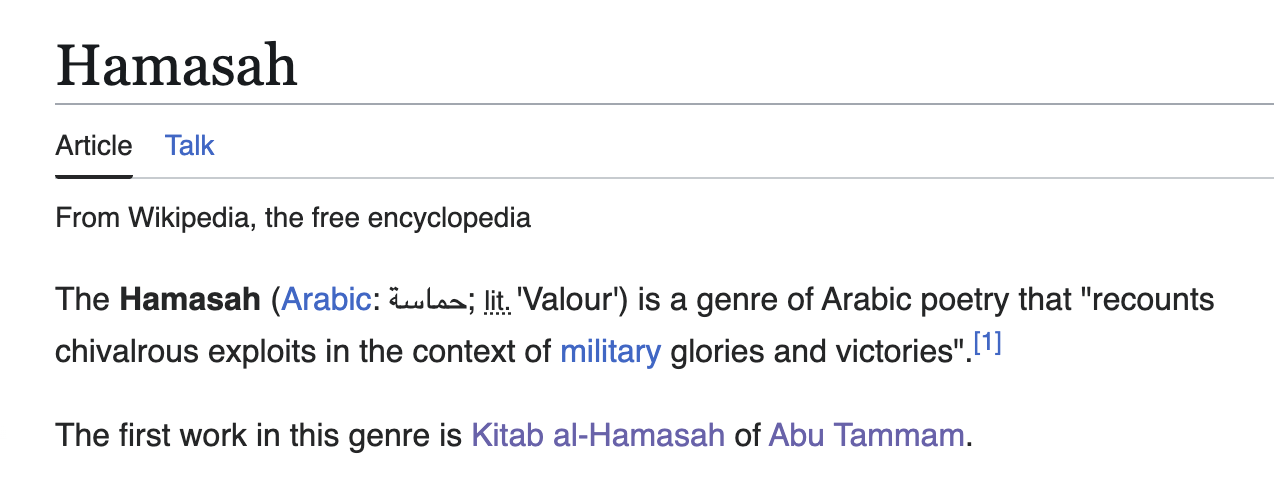
It contains not only chivalrous odes but also romantic passages, verses on good manners, and more.
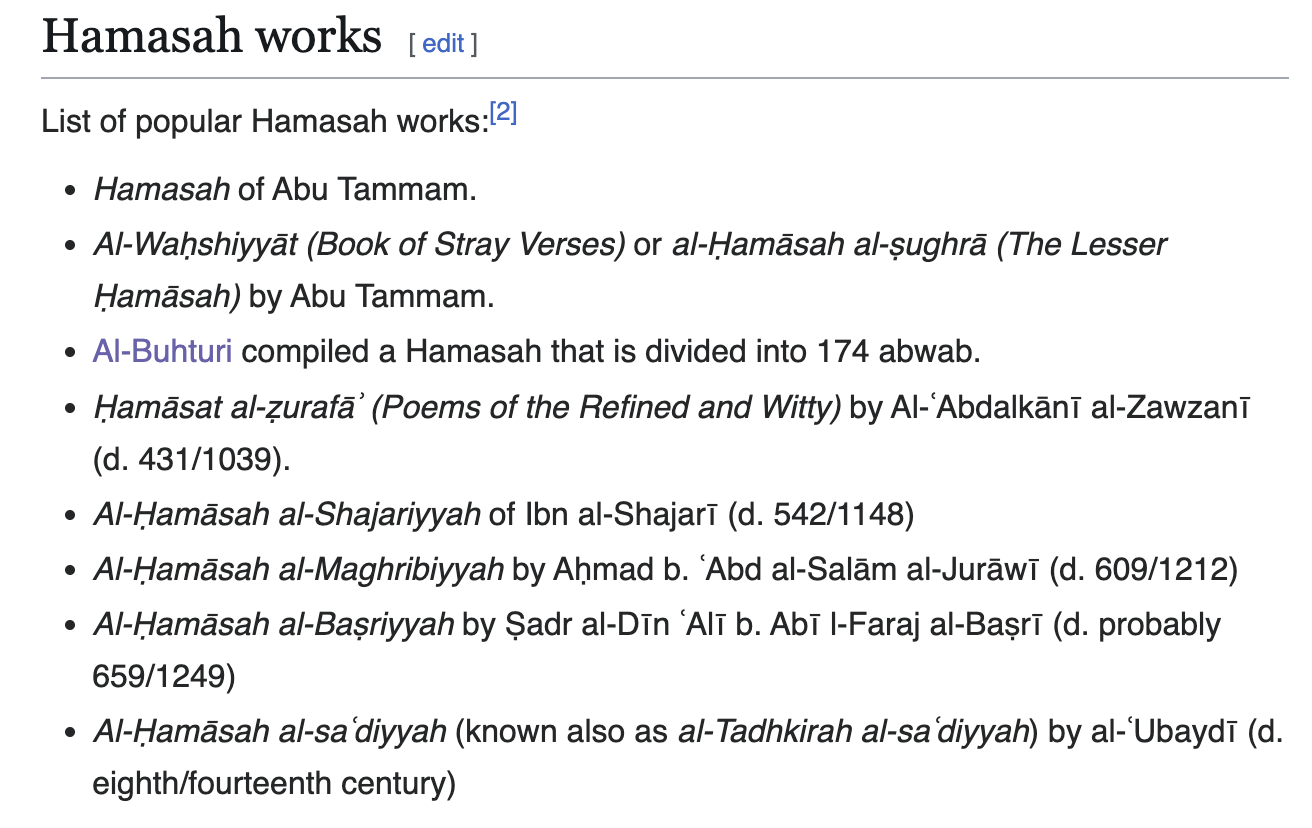
Following Abu Tammam, famous poets and scholars mimicked Abu Tammam and created their own versions of it, namely Hamasat al-Buhturi (before 284 AH), Hamasat al-zurafa (Poems of the Refined and Witty) by al-Abdalakani al-Zawzani, and many more:
One important thing to note is that this is not the first work of literature in which a collection of poetry was assembled (albeit very close to the start of the written form tradition, which was in the 7th century CE due to the revelation of the Quran). There were actually many books of this kind, for example: Mufaddaliyyat, roughly 145-168 AH (762-784 CE), by al-Mufaddal ad-Dabbi, Asmaiyyat by al-Asmai 122–213/218 AH (740–828/833 CE), Jamharat Ash’ar al-Arab by Abu Zayd al-Qurashi, who died in 170 AH (786 CE), and many more. What set those earlier collections apart, however, is that they assembled complete, long-form poems, unlike the short excerpts of the Hamasah genre. For context, the Islamic Golden Age is traditionally understood to have begun during the reign of the Abbasid caliph Harun al-Rashid, 169 AH – 193 AH (786–809 CE). That is when the urbanization of Islamic society reached its highest rate of growth. Let’s plot these numbers on a line and see if we notice a pattern:

Can you notice something?
What you may have noticed is that the Hamasah genre emerged, whether coincidentally or not, after the Islamic civilization surge. Can that be a fluke, or is there a theory that can explain such an emergence of short-form content?
Social Acceleration
Consider the “Social acceleration” phenomenon, a sociological concept pioneered by Hartmut Rosa. It describes how, with recent technological advancement and globalisation of our society, the pace at which our ancestors lived has become insufficient to keep up with such changes. Linear time, which manifested in recurring events like seasons or day-night cycles, has become insufficient, and an abstract time has emerged with a different slope depending on the necessity of the person and their environment, mostly sharper, as our society becomes increasingly dynamic.
Within Rosa’s framework, I would like to propose (Rosa may have suggested this himself, though I cannot confirm) that this social acceleration phenomenon is a recurring pattern accompanying the rise of each empire, consider Ibn Khaldun’s four stages of empire theory. This fits nicely with my proposition: the hidden reason behind the appearance of the “Hamasah” genre is the social acceleration brought about after the civilizational growth the Islamic region experienced in the late 7th century CE. The Hamasah genre was a shorter form of entertainment that the nature of that abstract time required. With more sophisticated societies come faster forms of entertainment consumption, think of the progression: books, then journals, then cinema; now, in our time, it is reels, Shorts, and TikToks, everywhere we look. And just as those reels and TikToks are short individually yet people still spend hours scrolling through them, the Hamasah books were hefty volumes made up of countless short excerpts; the consumption shifted from few long pieces to many short ones.
À la prochaine!